
Hotel booking trends 2026: What the data means for UK hospitality

Share


SiteMinder’s latest Hotel Booking Trends report is built from more than 130 million reservations across 20 key destinations, giving a uniquely data‑driven view of demand heading into 2026.
This year’s findings point to a market that has largely stabilised after the post‑pandemic rebound – but is far from static. Global guests are booking earlier, cancelling less, and spreading trips more evenly across the calendar, while the UK is emerging as a classic short‑stay, domestically driven market with a more layered mix of booking channels.
Global booking trends every UK operator should know

The global picture in Hotel Booking Trends is one of strengthened confidence and more even demand through the year:
- 1
Shoulder seasons are challenging peak periods.
In 65% of markets analysed, the busiest month of the year accounted for a smaller share of annual arrivals in 2025 than in 2024, as guests travelled more in spring and autumn as well as over traditional peaks.
- 2
Room rates continued to rise.
Average daily rate (ADR) increased in around 70% of markets, with the global ADR reaching US$194, reflecting travellers’ willingness to pay for better experiences.
- 3
Asian outbound demand is reshaping revenue.
Outbound travel from China and India surpassed pre‑pandemic levels for the first time, helping channels like Agoda and Trip.com climb or debut in many countries’ Top 12 revenue‑generating booking sources.
- 4
Direct channels continue to punch above their weight.
Hotel websites again generated the highest value bookings, with average revenue per direct booking significantly above OTAs and other intermediaries, underscoring the importance of a strong, conversion‑ready direct channel strategy.
What the data reveals about the UK hotel market
Against this backdrop, the UK stands out as a market where core patterns have settled into a new normal, rather than continuing to swing year‑to‑year.
- 1
Slightly higher rates, slightly fewer cancellations
SiteMinder’s data shows that UK ADR rose from ?189.00 in 2024 to ?191.55 in 2025, while the cancellation rate edged down from 18.27% to 18.24%, remaining below the global benchmark of 19.15%. In other words, revenue per booked room is nudging upwards, and more of those bookings are sticking.
- 2
A short‑stay market anchored by domestic guests
Around 80.5% of UK hotel stays are for just one night, one of the highest single‑night shares among the 20 markets analysed with domestic guests accounting for roughly 69% of check-ins. For many properties, especially in cities and transport hubs, this confirms what operators see daily: a backbone of local, one‑night guests, often travelling for work, events, or short leisure breaks.
- 3
Seasonality and pricing: Friday highs, January lows
Seasonality in the UK is starting to soften, but familiar patterns still apply. August remains the busiest month for check‑ins, while October and December are gaining importance. On the pricing side, January is still the cheapest month to stay, at around ?150 on average, whereas July is now the most expensive, at about ?215. At a weekly level, Friday is consistently the priciest night to check in, with Sunday the softest.
- 4
A more layered mix of booking channels
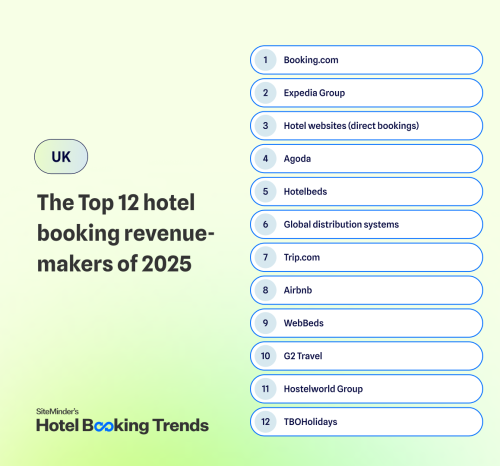
The UK’s Top 12 revenue‑generating booking sources now reflect a richer mix of OTAs, direct, and B2B channels. Global giants Booking.com and Expedia remain the top two revenue drivers, with direct bookings right after. Agoda has consolidated fourth place, benefitting from stronger inbound travel from Asia. London‑based tour operator G2 Travel appears in the rankings for the first time, while TBOHolidays, an Indian B2B player, maintains its foothold. This points to a UK distribution landscape where specialist B2B and wholesale partners increasingly complement the familiar OTA‑and‑direct split.
Three practical moves for UK hoteliers
- 1
Design product and revenue strategies around short stays
With four in five stays lasting a single night, revenue growth depends on maximising value per stay. Packaging high‑value experiences, from late check‑out and breakfast bundles to parking, workspace access or spa slots, allows hotels to lift spending without relying on longer trips.
- 2
Get sharper on pricing by day and season
More even demand through the year, combined with clear weekly pricing patterns, calls for more dynamic revenue tactics. Using real‑time data to adjust rates several times a week is particularly important around Fridays and Sundays, when price sensitivity and willingness to pay differ. Hotels can also lean into shoulder seasons city‑break offers, when demand is rising but price resistance is lower.
- 3
Treat channels as a portfolio, not a hierarchy
With direct, OTA and B2B sources all playing distinct roles, channels are best managed as a portfolio rather than a simple hierarchy. Protecting and growing the direct booking channel, while using channels like Agoda, Trip.com and B2B partners such as G2 Travel and TBOHolidays to reach specific segments, including long‑haul Asian travellers, groups and packaged demand. Regular reviews of channel mix help ensure the right partners are bringing the right guests at the right price.

Access SiteMinder’s Hotel Booking Trends report HERE for a global snapshot of how guests are booking, spending, and staying, and explore market‑by‑market insights.
In addition, register HERE for SiteMinder’s upcoming Hotel Booking Trends webinar, where experts will unpack these findings for UK hoteliers.