How to see through greenwashing and make better circular choices

Adriana Olaya Rodriguez, Sustainability and Communications Manager at Rubbermaid Commercial Products (RCP)
Share


As climate challenges continue to mount across the globe, there’s growing pressure on all of us to do our bit to reduce our environmental impact.
For hospitality businesses, that means choosing products and services with lower impacts. It’s a simple switch, but one that’s particularly difficult to make. But the challenge isn’t a lack of options. It’s that the choice can feel overwhelming, something that’s made even worse with the rise of greenwashing muddying the waters.
So, when many products claim to be “eco-friendly” or better for the environment, how do you know which claims are credible and which are not?
The problem with greenwashing
Before we go any further we should define exactly what greenwashing is…
For those who don’t know, greenwashing is the act of misrepresenting (whether deliberately or not) the environmental credentials and sustainability performance of your products. And the scale of the problem is bigger than you may think.
According to the European Commission, 53% of green claims are vague or unfounded, and 40% have no evidence to back them up. It’s no surprise then that regulators are taking note. Across global markets, rules on environmental marketing are tightening. In the EU for example, the Empowering Consumers for the Green Transition Directive will ban generic claims such as “eco-friendly” or “sustainable” unless backed by recognised evidence, while prohibiting offset-based “carbon neutral” product claims.
In a world where everyone is trying to do their bit to tackle the climate crisis, greenwashing is a real issue because it distracts or delays us from taking meaningful action. And for hospitality businesses that are looking to make informed procurement decisions in order to hit sustainability targets, it can be particularly damaging.
After all, there’s a real risk of choosing products that appear more sustainable than they actually are. This isn’t just frustrating, it can have real impacts. That’s because businesses that get caught on the wrong side of greenwashing, even unintentionally, don’t just risk falling foul of regulations. They risk damaging consumer trust, investor confidence and long-term market positioning.
How to see through false claims
Unlike the vague marketing terminology that you’ll find with greenwashing, companies that genuinely care about their environmental claims will take steps to back them up with hard data and third-party accreditation.
For a good portion of environmental claims, where environmental impact can be measured, a key tool that helps to separate true claims from greenwashing is to check whether there is a significant environmental benefit running a Life Cycle Assessment using recognized methodologies like ISO standards or PEF (Product Environmental Footprint), the EU recommended LCA based method. Requiring rigorous, standardized and science-based evaluation of a product’s entire life cycle, a Life Cycle Assessment is the gold standard for measuring a product’s environmental impact as it tracks the entire life cycle from raw material extraction through end of life as well as multiple impact indicator simultaneously like climate, water, and resources used impacts.
This big picture approach encompasses every aspect of a product and how it impacts the environment. The end result are product claims that are grounded by facts.
How to test green claims
Choosing products supported by a Life Cycle Assessment (LCA) conducted using ISO‑compliant methodologies enables hospitality businesses to access transparent, science‑based environmental data. While an LCA does not automatically mean a product performs better environmentally or is circular, it provides a credible basis for understanding impacts and comparing options, making it a strong starting point for informed decision-making.
If this isn’t available, however, there are some key questions that you should ask to distinguish genuine claims from greenwashing:
- 1
Is it specific?
Credible claims clearly describe what is being assessed and how. So, any product that makes vague claims like “planet-friendly” or “low impact” is a strong indication that the claim may not be trustworthy.
- 2
Is it measurable?
Can the claim be verified against data? Look for science-based and recognized methodologies, or reliable third-party certification with transparent disclosure of data, assumptions, and methods used.
- 3
Is it relevant?
Is the product talking about its impact across its whole life, or just pointing to one impressive-sounding detail? If it’s only focusing on one part, that could be cause for alarm.
- 4
Is it understandable?
Claims should use clear, jargon-free language that helps buyers interpret results accurately, without fine print that contradicts or undermines the headline.
- 5
Is it accessible?
Can you actually see the supporting evidence? Genuine transparency means documentation isn’t just promised, it’s easy to find and independently verified.
Environmental claims matter
The hospitality industry has the opportunity to make decisions that put sustainability front and centre. But those decisions need to be based on something real. Choosing products that are backed by rigorous, science-backed assessments and third-party accreditation isn’t just a protection from greenwashing, it’s a statement that your business believes in making genuine progress.
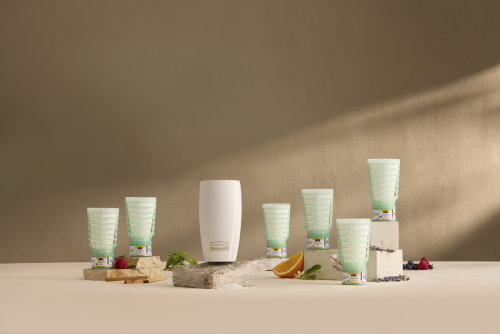
That’s why products like Rubbermaid Commercial Products’ CirculAir 90™, the next evolution of the popular TCell™ passive air freshening system, have been designed, tested and certified by Recyclass to be recyclable in EU, UK, NO, and CH and an ISO-compliant third-party verified LCA has been run to proof its environmental performance improvement. Because in a world of greenwashing, we know you need products that actually deliver on their promises.
Find out more


Placemaking report launched as a blueprint for the high street
The report sets out how removing regulatory barriers, alongside tackling cost pressures, would allow hospitality to thrive as a placemaker.