
Deposit Return Scheme – overview
With the Deposit Return Scheme starting across Great Britain in October 2027, we've created an overview for members and what they can expect.

What is a Deposit Return Scheme?
A Deposit Return Scheme (DRS) is designed to increase incentives for recycling and reduce litter within a population. Recycling is encouraged by adding a deposit to the price of drinks containers, which consumers get back if they return the empty container for recycling.
The UK's Deposit Return Scheme
The UK government and devolved administrations have confirmed that Deposit Return Schemes will be launched across the UK (England, Northern Ireland, and Scotland) in October 2027. The Welsh government have confirmed that they will be pursuing a Deposit Return Scheme that is markedly different, that will operate in the rest of the UK. Most notably, it will include glass.
We’ve broken down what the UK’s scheme requires from businesses when it is eventually launched.
Download the Exchange for Change PDF guidance

How does this affect hospitality?
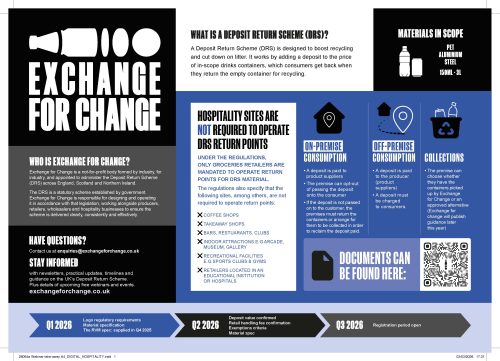
Under the new regulations, hospitality sites will not be required to operate DRS points, unless they are a grocery retailer. Only grocery retailers are mandated to operate return points for DRS material.
The following sites are also specified in the regulations as exempt from mandatory operation:
- Coffee shops
- Takeaway shops
- Bars, restaurants, clubs
- Indoor attractions e.g. arcade, Museums, galleries
- Recreational facilities e.g. sports clubs and gyms
- Retailers located in an educational institution or hospitals
How does it work?
On-premise consumption
On-premise consumption refers to products, typically food or beverages, that are purchased and consumed at the same location where they are sold.
- 1
A deposit is paid to product suppliers
- 2
The premise can opt-out of passing the deposit onto the consumer
- 3
If the deposit is not passed on to the customer, the premises must return the containers or arrange for them to be collected in order to reclaim the deposit paid
Off-premise consumption
Off-premise consumption refers to products being taken away and consumed elsewhere after purchase.
- 1
A deposit is paid to the producer (product suppliers)
- 2
A deposit must be charged to consumers
Collections
Collections refers to the processes and logistics involved in retrieving returned containers from return points and transporting them to counting, sorting, and recycling facilities.
- 1
The premise can choose whether they have the containers picked up by Exchange for Change or an approved alternative (Exchange for Change will publish guidance later this year)
Deposit level
Exchange for Change has confirmed that there will be a flat 20p deposit for all in scope drinks containers under DRS. This was a recommendation of UKHospitality as a means of minimising confusion under the scheme.
We are continuing to work closely with Exchange for Change on all matters DRS and will keep members updated with future developments.
Deposit Return Scheme Timeline
Q1 2026
- Logo regulatory requirements
- Material specification
- The RVM spec: supplied in Q4 2025
Q2 2026
- Deposit value confirmed
- Retail handling fee confirmation
- Exemptions criteria
- Material spec
Q3 2026
- Registration period open
A bit about Exchange For Change
Who are they?
Exchange for Change is a not-for-profit body formed by the industry, for the industry, and appointed to administer to Deposit Return Scheme (DRS) across England, Scotland, and Northern Ireland.
The DRS is a statutory scheme established by government. Exchange For Change is responsible for designing and operating it in accordance with that legislation, working alongside producers, retailers, wholesalers and hospitality businesses to ensure the scheme is delivered clearly, consistently and effectively.
Find out more
Holiday tax scheme proposal – what to know
We break down the Government’s response to its consultation on a holiday tax and set out the proposals as they stand.

No time, no budget? Christmas is exactly when training matters most
The Government’s withdrawal of an updated tipping code of practice less than three months before implementation has left hospitality in limbo, UKHospitality said.

Procurement and the supply chain in hospitality, leisure and food & drink: A margin-defining priority
The Government’s withdrawal of an updated tipping code of practice less than three months before implementation has left hospitality in limbo, UKHospitality said.


Continue reading
Join over 750 members who have exclusive access to latest news, online support, policy updates and much more.