Beyond the thermostat: Why data is the new member of your maintenance team

Share


For the average UK hotelier in 2026, the “room check” is a race against time.
With the recent April hikes in the National Living Wage and a persistently tight labor market, maintenance teams are often stretched to their breaking point. The traditional reactive model of hotel maintenance: waiting for a guest to complain – is still the norm for many. But what if we could use data as a diagnostic tool?
A quiet revolution is happening within the walls of the guest room. By looking beyond simple energy savings, forward-thinking operators are discovering that their smart energy management systems are actually their most sophisticated diagnostic devices.
From "off" to "optimised"
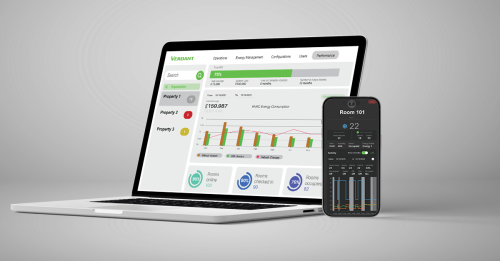
The primary job of an occupancy-based thermostat is to adjust HVAC levels in empty rooms and significantly reduce energy consumption. While doing this, it also generates a continuous stream of performance data. Every room has a “thermal signature”: a predictable pattern of how long it takes to heat or cool based on the outside temperature, equipment health, and room size.
When a system is truly “smart,” such as the energy management solutions from Verdant by Copeland; it notices the anomalies. If the HVAC in Room 302 is running at 100% capacity but the ambient temperature is only dropping by 0.5°C per hour, the system knows something is wrong before the guest even checks in. This isn’t just an energy efficiency issue; it’s an early warning sign of a clogged filter, a failing compressor, or even a window seal that has perished. It acts as a real “Staff Force Multiplier,” identifying underperformance before it becomes a complaint. This level of insight is a financial game-changer. Industry data consistently shows that reactive maintenance is three to four times more costly than preventative maintenance.
The "invisible" service recovery
In the age of instant TripAdvisor and Google reviews, a “room move” due to faulty air conditioning is a failure of service. It disrupts the guest, creates extra work for front-of-house staff, and often results in a discounted stay or a negative rating.
Data-led maintenance flips this script. By using predictive alerts, maintenance leads can be surgically precise. Instead of wandering corridors for “preventative” checks on perfectly functional units, they can head straight to the specific rooms the data flagged as underperforming. It allows teams to fix the “silent” issues during turnover windows, ensuring that by the time the guest turns the key, the room is performing exactly as promised.
In 2026, the most profitable room in a UK hotel isn’t necessarily the Penthouse suite – it’s the one that never goes “Out of Order.” By moving beyond the thermostat and embracing the data-led maintenance revolution, operators aren’t just saving energy; they are protecting their assets, their staff’s time, and most importantly – their reputation.