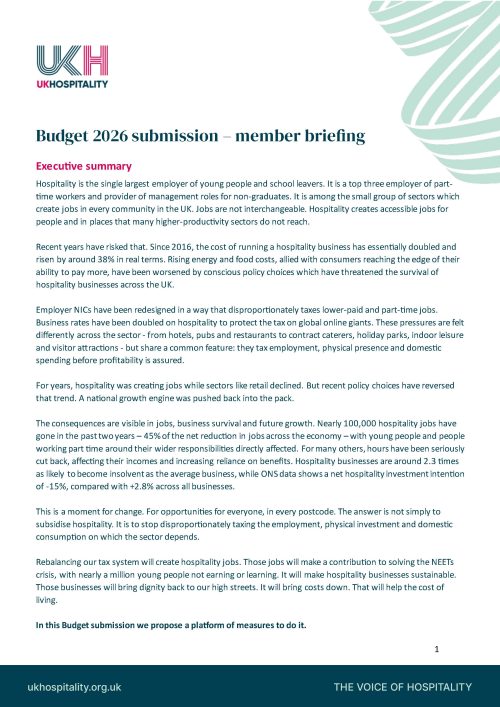
Hospitality is the single largest employer of young people and school leavers. It is a top three employer of part-time workers and provider of management roles for non-graduates. It is among the small group of sectors which create jobs in every community in the UK.
Jobs are not interchangeable. Hospitality creates accessible jobs for people and in places that many higher-productivity sectors do not reach.
Recent years have risked that. Rising energy and food costs, allied with consumers reaching the edge of their ability to pay more, have been worsened by conscious policy choices which have threatened the survival of hospitality businesses across the UK.
Employer NICs have been redesigned in a way that disproportionately taxes lower-paid and part-time jobs. Business rates have been doubled on hospitality to protect the tax on global online giants. These pressures are felt differently across the sector – from hotels, pubs and restaurants to contract caterers, holiday parks, indoor leisure and visitor attractions – but share a common feature: they tax employment, physical presence and domestic spending before profitability is assured.
Share


Briefing note

For years, hospitality was creating jobs while sectors like retail declined. But recent policy choices have reversed that trend. A national growth engine was pushed back into the pack.
The consequences are visible in jobs, business survival and future growth. Nearly 100,000 hospitality jobs have gone in the past two years with young people and people working part time around their wider responsibilities directly affected.
For many others, hours have been seriously cut back, affecting their incomes and increasing reliance on benefits. Hospitality businesses are more likely to become insolvent than the average business, while hospitality investment intention is significantly lower than the wider economy.
This is a moment for change. For opportunities for everyone, in every postcode. The answer is not simply to subsidise hospitality. It is to stop disproportionately taxing the employment, physical investment and domestic consumption on which the sector depends.
Rebalancing our tax system will create hospitality jobs. Those jobs will make a contribution to solving the NEETs crisis, with nearly a million young people not earning or learning. It will make hospitality businesses sustainable. Those businesses will bring dignity back to our high streets. It will bring costs down. That will help the cost of living.
Our asks
Four measures to back hospitality growth
- 1
Cut VAT to 10% for hospitality
Bringing the UK closer to the tax treatment of hospitality across international competitors and giving businesses the headroom to invest, create jobs and keep prices down, with the reduced rate also covering paid visitor attractions.
- 2
Fix business rates for hospitality
Finish the job of repairing the damage caused by the 2026 revaluation, by increasing the RHL multiplier discount towards 20p, removing hospitality businesses from the surcharge on properties with a rateable value above £500,000, and providing a 20% discount for hotels and other businesses hardest hit by the 2026 revaluation – in line with the pub sector support.
- 3
Reduce employer NICs
Commit to increase the universal employer NIC Secondary Threshold to £10,000 by April 2029, reversing and expanding on the pre-2025 threshold and reducing the tax penalty on lower-paid, part-time and flexible employment.
- 4
Deliver devolution by replacing the holiday tax with a tourism bonus
Supporting destinations to invest in their visitor economies without imposing an additional tax on families and the businesses that accommodate them, through devolved funding linked to tourism growth.

Write to your MP ahead of the Budget
The change of Prime Minister has seen a more positive approach from Government towards hospitality and the Budget will be the first opportunity to test whether actions meet the positive narrative we have heard around youth employment, high street regeneration and growth in every postcode.
It’s crucial that MPs hear from their constituents about the need to back hospitality.
Write to your local MP, using our simple tool.

Find out more
Back hospitality to solve NEETs crisis, sector’s rising stars urge Government
A group of under-30s that are examples of hospitality’s career potential have urged Govt to not make the next generation the lost generation.