
Deposit Return Scheme – overview
September 28, 2026
With the Deposit Return Scheme starting across Great Britain in October 2027, we've created an overview for members and what they can expect.
What is a Deposit Return Scheme?
A Deposit Return Scheme (DRS) is designed to increase incentives for recycling and reduce litter within a population. Recycling is encouraged by adding a deposit to the price of drinks containers, which consumers get back if they return the empty container for recycling.
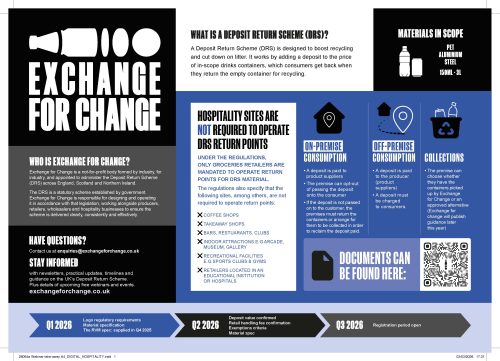
Download the Exchange for Change PDF guidance

How does this affect hospitality?
Under the new regulations, hospitality sites will not be required to operate DRS points, unless they are a grocery retailer. Only grocery retailers are mandated to operate return points for DRS material.
The following sites are also specified in the regulations as exempt from mandatory operation:
- Coffee shops
- Takeaway shops
- Bars, restaurants, clubs
- Indoor attractions e.g. arcade, museums, galleries
- Recreational facilities e.g. sports clubs and gyms
- Retailers located in an educational institution or hospitals
Download the Deposit Return Scheme (DRS): Guidance for hospitality businesses
Summary
DRS is designed to increase recycling rates for single-use drinks containers across the UK. Businesses that sell or supply in-scope drinks containers have legal obligations dependent on how and where the drink is sold or consumed.
From 1 October 2027, customers will pay a refundable 20p deposit for in-scope single-use drink containers, with a capacity of 150ml to 3 litres, made from:
- PET Plastic
- Aluminium
- Steel
- Glass (in Wales only)
Exchange for Change (EfC) has been appointed as the Deposit Management Organisation (DMO, also known as a scheme administrator in Scotland), to manage DRS operations in England, Northern Ireland, Scotland and recently Wales. With the Welsh Government only appointing EfC as the DMO in August, this guidance relates to England, Northern Ireland and Scotland only. EfC is a not-for-profit, formed by industry, and has published information for hospitality businesses. EfC will share more information in the new year, including how to register, what data you may need to retain, how to store empty containers, what’s needed to prepare for collections, and what signage you should display on premises.
Hospitality businesses are only mandated to apply deposits on drinks containers sold for consumption away from the premises, and are not required to operate a return point, but can do voluntarily (VRP).
Detail
Selling drinks for consumption on premises in England and Northern Ireland
- If you sell drinks for immediate consumption on the premises you can choose whether to charge the deposit to consumers at the point of sale.
- If you choose to pass the deposit onto consumers, you do not have to collect any of the containers and the consumer will need to return the container to a return point to redeem their deposit.
- If you do not pass the deposit onto consumers, you should collect and retain the containers on the premises and store these securely. (NB there is no handling fee for hospitality in the regulations). If you choose to host a return point, EfC will be providing a collection free of charge, with containers taken for counting and verification before then providing deposit reimbursement to businesses.
- If you have decided not to charge the deposit, you must display clear information that says you are an opt-out premises, and ask customers to leave their empty containers.
Selling drinks for consumption on premises in Scotland
- EfC is in discussion with Scottish Government to clarify the position for drinks sold for consumption on premises in Scotland.
- Currently, the regulations make provisions for hospitality businesses to not charge the deposit on drinks containers sold for consumption on premises, and packaging should be retained by the hospitality business for collection by EfC.
- EfC is clarifying with the Scottish Government if hospitality businesses in Scotland, selling drinks for consumption on the premises can choose to charge the deposit if they wish (noting the standard approach would be to not charge the deposit). Given there is flexibility for this under the England / Northern Ireland scheme, EfC is clarifying if similar flexibility is to be offered under the Scottish regulations.
Selling drinks for consumption off premises in England, Northern Ireland and Scotland
- Any drinks sold for consumption off the premises must have a deposit charged to the consumer. Consumers will then have to take the container to a return point to receive a deposit refund.
- Where a hospitality business sells drinks for consumption both on the premises and as takeaway, the relevant guidance applies – drinks sold for consumption off the premises must have the deposit charged, and those drinks containers sold for consumption on the premises can be supplied without the deposit.
Financial and operational workflow
1. Purchasing Stock: You pay the product cost + 20p deposit per unit to your supplier.
2. Serving Customers: A hospitality premises decides whether or not to pass on the deposit (in line with the guidance above).
a.If the deposit is not passed on, then the premises should seek to collect and store those
containers on site for collection and return into the scheme.
b.If the deposit is passed on, then the consumer has responsibility to return the container to a return point to redeem their deposit.
Points three and four below are only applicable if you choose to host a VRP.
3. Storage: Staff aggregate empty containers into dedicated, barcode-scannable DMO collection bags/crates, held securely for collection.
4. Collection and reimbursement: EfC organises the collection of bags/crates, weighs/counts/scans the empty containers, and reimburses your business for the total deposit value paid upfront.
Considerations for hospitality operators
Data management
- Register with EfC: If you choose to host a VRP, you will need to set up an account with EfC and establish payment details for deposit reimbursements.
- Audit product listings: Identify all in-scope containers currently stocked to carry a DRS logo/barcode. All containers affected will require new barcodes, registered by the
producer/supplier, ahead of scheme launch. - Review Point of Sale systems: Configure EPOS to ensure a deposit is applied (deposit is not subject to VAT).
Collections
- Deposit process: Consider if you will charge / not charge the deposit on containers which are sold for consumption on the premises (noting this flexibility is still being clarified for Scotland). In situations where no deposit is applied, there is a risk that containers could leave the premises, so consider retaining containers at the point of sale, clear signage, and collection bins to prevent deposit revenue losses.
- Training: Training of staff to manage protocols, such as container handling, segregation processes, storage and cleaning may be required.
- Container management: Empty containers must not be crushed, flattened, or compacted prior to collection. Labels and barcodes must remain intact and legible so the DMO can verify the scheme article status during reverse logistics processing.
- Allocate storage – scheme containers must be kept separate from general commercial recycling or general waste streams. Contaminated containers (e.g., filled with food waste, cigarette butts, or liquids) may be rejected resulting in a
loss of deposit reimbursement. - Low collection volumes: For premises receiving low volumes of empty containers, they can choose to claim deposits, by returning empty containers to local return points, rather than register and administrate EfC collections.
- VRP: EfC will shortly release guidance as to how businesses, which are not mandated to operate return points, can apply to be a VRP operator.
Wales
- Glass: Wales will include glass in its DRS, and has designed a transition period whereby single-use glass bottles will not carry a deposit or any DRS labelling / logo for the first 4 years of the scheme.
- From October 2031, deposits and DRS labelling requirements on single-use glass bottles will become mandatory. The scheme utilises DRS return points and existing kerbside infrastructure.
- However, it is not yet clear how; identical stock sold in glass across the UK will be identified, cross border fraud/misreporting will be prevented, how the scheme is funded at the kerbside, if additional costs will be applied due to this new trade barrier, or if producers may choose to de-list stock sold in Wales.
- Other: Wales will require containers, of those collected, to be reusable; 5% from 2031 and 15% from 2032, and EfC will share more detail about this in due course.
A bit about Exchange For Change
Who are they?
Exchange for Change is a not-for-profit body formed by the industry, for the industry, and appointed to administer to Deposit Return Scheme (DRS) across England, Scotland, and Northern Ireland.
The DRS is a statutory scheme established by government. Exchange For Change is responsible for designing and operating it in accordance with that legislation, working alongside producers, retailers, wholesalers and hospitality businesses to ensure the scheme is delivered clearly, consistently and effectively.
Find out more

Placemaking report launched as a blueprint for the high street
The report sets out how removing regulatory barriers, alongside tackling cost pressures, would allow hospitality to thrive as a placemaker.

Continue reading
Join over 750 members who have exclusive access to latest news, online support, policy updates and much more.